

Federated
Manage centrally, break out locally
One Fleet Manager handles identity and policy across sites. Each site can host its own concentrators or share a regional pool. Subscriber traffic exits at the property or nearest edge over the available circuits.

How traffic flows
-
The device joins
A phone or laptop connects to a MaxLinear initiator: an access point or switch on site.
-
The initiator tunnels
It tunnels each tenant’s traffic in the software-defined access network (SDAN) overlay. In a VXLAN deployment, each tenant has its own VXLAN network identifier (VNI).
-
The underlay carries it
Any IP path works. GRE suits a private path; a path that crosses NAT uses VXLAN.
-
The concentrator receives it
A BlueField-3 DPU concentrator, on site or regional, hands it to the tenant’s virtual gateway (vGW).
-
The vGW applies policy
Firewall, NAT and bandwidth policy apply. Traffic carries the tenant’s own public IP.
-
Traffic breaks out
It exits where the vGW runs: through the property’s uplinks or at the nearest edge.
What runs where
Policy is enforced where each vGW runs. Fleet Manager manages every site’s rXg from one place.
| Component | Where it runs | What it does |
|---|---|---|
| Initiator | MaxLinear SoC access points and switches | Starts each tenant’s SDAN tunnel |
| Underlay | The site’s existing IP access network | Carries the tunnel |
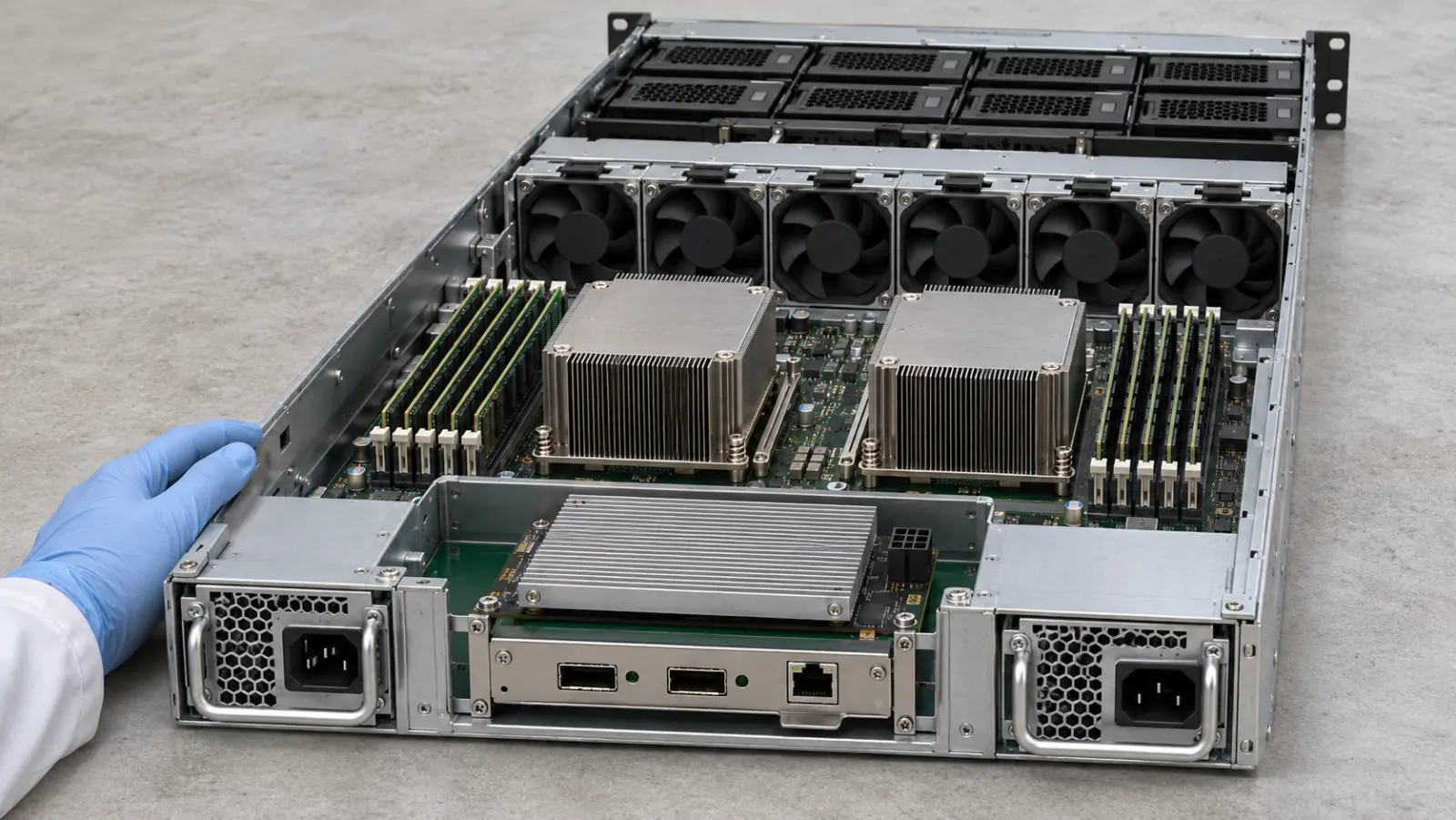
| Concentrator | NVIDIA BlueField-3 DPUs, on site or in a regional pool | Terminates tunnels and forwards tenant traffic |
| vGW | On the concentrator that serves the site, on site or regional | Applies each tenant’s firewall, NAT, bandwidth policy and public IP |
| rXg controller | At each site, or shared by a region’s smaller sites | Directs initiators and concentrators, handles policy and billing, and allocates public IPs on demand, tied into BGP |
| Fleet Manager | One central rXg, or a high-availability pair | Pushes templates and upgrades, keeps backups, centralizes authentication |
| AI diagnostics | NVIDIA Blackwell GPUs on the operator’s premises | Interprets access point tests and DPU telemetry, off the forwarding path |
| Internet breakout | Where the vGW runs: the property’s uplinks or the nearest edge | Sends Internet-bound traffic out where circuits and latency requirements allow |
When to choose it
Sites keep their own circuits
Traffic exits where circuits and latency requirements allow: through a site’s own uplinks or at the nearest edge.
Large and small sites mix
Cost per room shapes the split. A flagship hotel or large campus can host its own gateway and controller; smaller sites can share them regionally.
One policy spans many sites
Fleet Manager applies one set of rules across a brand’s hotels or a business’s branches. A district manages policy centrally for its schools.
Resilience
Two uplinks, diverse routes
Two dedicated Internet access uplinks provide link failover, and operators can assign specific applications to the uplink that real-time telemetry shows is more stable. Separately engineered metro routes add geographic resilience.
Clusters and pairs
A site’s rXg can run as a cluster. Fleet Manager can run on a symmetric pair for high availability.
Backups and recovery
Encrypted Fleet Manager backups restore a site’s configuration after a hardware failure. Regional failover depends on placement and recovery design.
Sizing
Size on-site concentrators for the subscribers at that property. For sites that share a regional pool, use their combined subscriber target.
The national capacity model allows 6,000 subscribers per DPU at 75% of raw capacity.
What your pilot proves
A pilot in one market tests the design against acceptance criteria agreed before we build.
-
Both exits
Breakout at a site’s own uplinks and at a regional concentrator, if the design uses both.
-
Failure tests and rollout
Uplink failover, a site restored from backup, and a Fleet Manager upgrade with a tested rollback plan.
-
Every element marked
Supported, assumed or awaiting validation, with lab and field results in your acceptance report.
Other designs
Plan a federated design
Before the pilot, our dated, versioned reference design sets where each site’s gateways run and where its traffic exits.